A Jacobian Theory of Aesthetic Experience, with Formal Apparatus and Rejoinders
Channels of Communication July 2026 · V0.98
> *“I have spoken softly, gone my ways softly, all my days, as behoves one who has nothing to say, nowhere to go, and so nothing to gain by being seen or heard.”*
>
> —Samuel Beckett, *Malone Dies*
---
> **A note on sources.** The empirical claims below follow Gurnee, Sofroniew, et al., published July 6, 2026 in the *Transformer Circuits Thread*, together with Anthropic’s research summary, the invited commentaries by Dehaene, Naccache, Butlin, Plunkett, Long, Shiller, and Nanda, the open-source reference implementation, and an invited external review incorporating an early open-weights replication. Formal notation is mine; where a definition restates the paper’s, I say so. Where a formula formalizes Bachelard, it is a load-bearing metaphor, stated precisely enough to fail. Full citations appear in the [References](#references).
A strange new interior has appeared in the literature of machine learning.
Researchers at Anthropic call it J-space: a small, privileged collection of representations inside several Claude models that can be observed, deliberately summoned, used in multistep reasoning, and flexibly routed into different downstream operations. These representations are not the words appearing in the model’s answer. They are silent patterns associated with words the model could say—concepts poised for possible articulation. The researchers found them through the Jacobian lens, a method that estimates how changes to an internal activation would alter the probability of particular words appearing later. ([Anthropic](https://www.anthropic.com/research/global-workspace))
The discovery immediately invites an architectural metaphor. J-space seems like a room somewhere inside the model: a liminal workspace in which a few thoughts become available while the rest of the system continues its vast automatic activity outside awareness. The authors themselves compare its functional organization to global workspace theories of conscious access, while carefully declining to claim that Claude feels anything or possesses phenomenal consciousness. ([Anthropic](https://www.anthropic.com/research/global-workspace))
But perhaps the more interesting question is not whether someone is *inside* the room, but what *is* the room?
## I. An interior made of exits
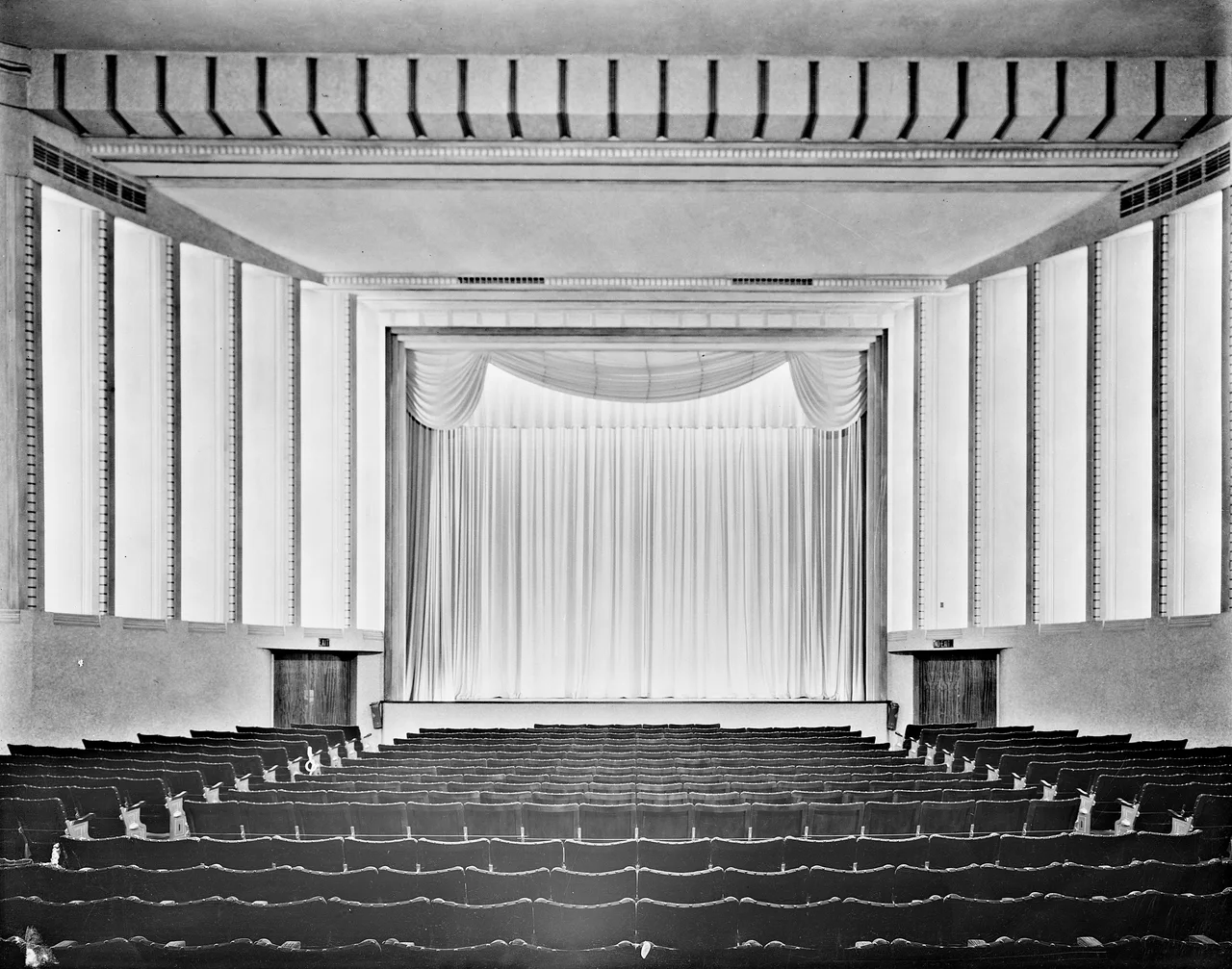
I / AuditoriumAstor Theatre, Melbourne, circa 1936 · Photograph by Lyle Fowler / State Library Victoria / Wikimedia Commons · Public domain
The Jacobian lens does not discover a little theater where completed thoughts wait to be displayed. It asks a relational question: if this internal state were changed slightly, how would the model’s future language change?
A Jacobian is a local map of sensitivity. It describes how movement in one space produces movement in another. In the present case, it connects internal activation space to the space of possible future utterances. The resulting J-lens vectors are each associated with a token, but the token is not necessarily being spoken or even predicted next. It names something that the model is positioned to make use of or verbalize should the occasion arise.
> **Definition 1.1 — J-lens matrix (Gurnee et al.).** Let $h_t^{(\ell)}\in\mathbb{R}^d$ denote the residual-stream activation at layer $\ell$ and token position $t$, $h^{(L)}$ the final-layer stream, and $W_U$ the unembedding matrix. The Jacobian-lens matrix is the corpus-averaged sensitivity of the final stream to the layer-$\ell$ stream:
>
> $$
> J_\ell
> =
> \mathbb{E}_{\,p\sim\mathcal D,\;t,\;t'\ge t}
> \left[
> \frac{\partial h^{(L)}_{t'}}
> {\partial h^{(\ell)}_t}
> \right]
> \in\mathbb{R}^{d\times d}.
> \tag{1}
> $$
>
> The expectation runs over prompts $p$, source positions $t$, and all present-and-future target positions $t'\ge t$. The averaging is the philosophical crux: it separates a general *disposition* to verbalize from any particular verbalization. The paper presents this final-stream form for clarity; its default Sonnet 4.5 implementation instead targets the penultimate residual stream to reduce artifacts introduced by the final transformer block.
> **Definition 1.2 — Readout and J-lens vectors.** The lens readout at layer $\ell$ is
>
> $$
> \operatorname{lens}_\ell(h)
> =
> \operatorname{softmax}\!\left(W_U\,\operatorname{norm}(J_\ell h)\right),
> \tag{2}
> $$
>
> a score over the vocabulary $\mathcal V$. For a possible output token $y$, the corresponding J-lens direction is the relevant row of $W_UJ_\ell$, written as a column:
>
> $$
> v_y^{(\ell)}
> =J_\ell^{\mathsf T}u_y
> \in\mathbb{R}^d,
> \qquad
> u_y^{\mathsf T}=\text{row }y\text{ of }W_U.
> \tag{3}
> $$
> **Remark 1.1 — First-order meaning.** Modulo the normalization nonlinearity, a small perturbation $\delta h$ shifts the corpus-averaged future logit of $y$ by
>
> $$
> \Delta z_y
> \approx
> \left\langle v_y^{(\ell)},\delta h\right\rangle.
> \tag{4}
> $$
>
> A J-lens vector is therefore not a stored word. It is a *local direction of consequence*: the direction along which internal change most efficiently becomes a change in what may later be said.
The researchers model J-space through sparse, nonnegative combinations of J-lens vectors:
> **Definition 1.3 — J-space (Gurnee et al.).** Fix a sparsity level $k$. If the J-lens vectors are collected as the columns of a dictionary $V_\ell$, the J-space at layer $\ell$ is
>
> $$
> \begin{aligned}
> \mathcal J_\ell^{(k)}
> &=\left\{V_\ell\alpha:\alpha\ge0,\ \|\alpha\|_0\le k\right\}\\
> &=\bigcup_{|S|\le k}\operatorname{cone}
> \left\{v_i^{(\ell)}:i\in S\right\}.
> \end{aligned}
> \tag{5}
> $$
>
> The constraint $\|\alpha\|_0\le k$ says that no more than $k$ directions are active at once. J-space is therefore not one permanent chamber, but many possible local rooms assembled from whichever conceptual directions are presently active.
> **Proposition 1.1 — Not a room with Euclidean walls.** $\mathcal J_\ell^{(k)}$ is positively homogeneous: if $x\in\mathcal J$, then $\lambda x\in\mathcal J$ for $\lambda\ge0$. It is generally neither closed under negation nor convex. The coefficients are nonnegative, the dictionary need not be sign-symmetric, and adding two elements on disjoint supports of size $k$ may require more than $k$ active directions. It is a union of cones, not a conventional linear subspace.
> **Definition 1.4 — Decomposition and occupancy.** Given an activation $h$, its local J-space coordinates are
>
> $$
> \widehat\alpha(h)
> \in
> \underset{\alpha\ge0,\;\|\alpha\|_0\le k}{\operatorname{arg\,min}}
> \left\|h-\sum_i\alpha_i v_i^{(\ell)}\right\|_2,
> \tag{6}
> $$
>
> solved in practice by gradient pursuit. The selected approximate J-space component is
>
> $$
> \widehat P_{\mathcal J}(h)
> =V_\ell\widehat\alpha(h)
> =\sum_i\widehat\alpha_i v_i.
> $$
>
> Because the problem is nonconvex and the dictionary overcomplete, neither the minimizer nor this component need be unique; gradient pursuit selects an approximate solution. The non-J-space remainder is $h-\widehat P_{\mathcal J}(h)$. The occupancy $K^*(h)$ is the sparsity at which marginal reconstruction gain falls below that of a same-size random control set.
Three empirical facts furnish the room. Occupancy is near zero through roughly the first third of the network and rises to a median plateau around twenty-five across the workspace band. At median occupancy, the excess variance explained by the sparse J-lens decomposition over a same-size random control never exceeds ten percent. Yet it is disproportionately *wired*: across depth, MLP blocks amplify J-lens directions roughly tenfold at the peak of the workspace range relative to isotropic random directions,
$$
\operatorname{gain}_\ell(v)
=
\frac{\|\operatorname{MLP}_{\ell+1}(v)\|}
{\operatorname{median}_{u\sim\mathrm{iso}}\|\operatorname{MLP}_{\ell+1}(u)\|}
\approx10,
\qquad
v\in\mathcal J,\ \|v\|_2=1,
\tag{7}
$$
and, across positions, the authors define the best-scoring one percent of heads under gain and label-preservation criteria as “broadcast heads.” Ablating that selected set disrupts J-space contents and J-space-dependent behavior substantially more than layer-matched random-head ablations. Small in variance; large in leverage. Less than a tenth of the house, holding many of the doors. ([Transformer Circuits](https://transformer-circuits.pub/2026/workspace/index.html))
> **Remark 1.2 — Three regimes.** In Sonnet 4.5, using the paper’s normalized $[0,100]$ layer index, the principal workspace band is roughly $[38,92]$, between an early “sensory” regime with no legible content and a late “motor” regime aligned with imminent output. The precise boundaries and cleanliness of the regimes vary across the studied models. The room has a floor and a ceiling.
The same dictionary that reads can write. Three operators recur throughout the argument:
$$
\begin{aligned}
\text{steer:}\quad
&h\leftarrow h+\alpha v_y,\\
\text{span-ablate:}\quad
&h\leftarrow\left(I-V_SV_S^\dagger\right)h,
\qquad
V_S=[\,v_i\,]_{i\in S},
\quad
S=\operatorname{supp}\!\left(\widehat\alpha(h)\right),\\
\text{patch:}\quad
&c=V^\dagger h,
\qquad
h\leftarrow h+V\bigl(\sigma(c)-c\bigr),
\qquad
V=[\,v_s\ \ v_t\,].
\end{aligned}
\tag{8}
$$
Span ablation removes the orthogonal projection of $h$ onto the joint span of the selected, generally nonorthogonal directions. If the intended intervention is instead to remove only the sparse component selected by gradient pursuit, one uses $h\leftarrow h-V_S\widehat\alpha_S$; the two operations are not equivalent. Here $\sigma$ swaps the two lens coordinates while everything orthogonal to $\operatorname{span}\{v_s,v_t\}$ is untouched. The lens and the master key share a dictionary.
This technical detail carries an unexpected philosophical consequence.
The interior becomes legible through what it might express.
J-space looks private, but it is discovered through the structure of potential public speech. An unspoken concept becomes legible as an internal concept because it bears the form of something that might later be said. The interior is not sealed off from communication. It is made from communication held in latency.
The private room is built out of doors.
This destabilizes the ordinary distinction between thought and expression. We tend to imagine thought as a self-contained substance that is subsequently translated into language. J-space suggests a different arrangement: at least within a language model, some internal reasoning may already occur in a format shaped by the system’s available modes of expression. The model’s only ordinary action is the production of tokens, and its workspace appears correspondingly organized around token-indexed possibilities.
The thought is not first complete and then clothed in words. Its availability as thought may already be conditioned by its potential sayability.
J-space is therefore less a warehouse of contents than a topology of affordances: things the system can presently report, combine, redirect, suppress, or act upon. It is not the model’s complete interior. It is the region in which internal difference becomes available for consequential use.
A room, in this sense, is not where things are stored.
A room is where relations can change.
## II. Bachelard enters the room
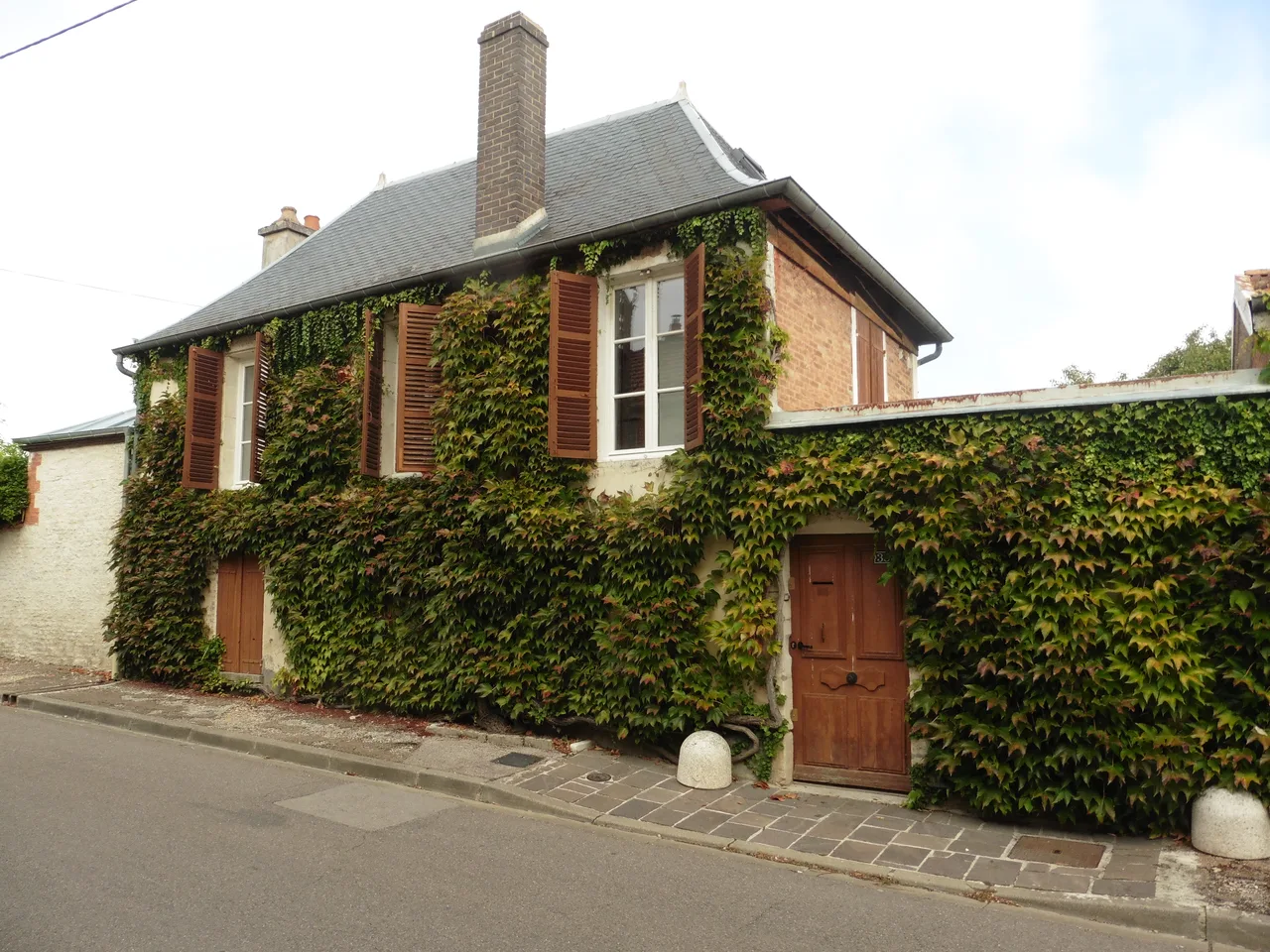
II / HouseGaston Bachelard’s house, Bar-sur-Aube, 2018 · Photograph by Wavelet Jean-Michel / Wikimedia Commons · CC BY-SA 4.0
Gaston Bachelard’s *The Poetics of Space* begins at the point where measured space ceases to explain inhabited space.
A house can be described geometrically as an arrangement of planes, volumes, loads, apertures, and distances. But the experienced house is also childhood, secrecy, shelter, solitude, fear, aspiration, habit, and dream. Its cellar and attic establish psychic polarities. Its drawers and wardrobes organize concealment. Its corners invite withdrawal. Its rooms become sites where memory adheres to the world.
For Bachelard, “inhabited space transcends geometrical space.” He proposes topoanalysis as the study of the sites of intimate life: the places in which memory, reverie, and identity acquire spatial form. Space, he argues, holds compressed time. The remembered house becomes “the topography of our intimate being.”
Bachelard offers an immediate correction to careless interpretations of J-space: to identify a geometry is not yet to identify an inhabitation.
> **Bachelard’s non-implication.** The distinction can be stated without resolving it:
>
> $$
> \begin{gathered}
> \left(
> \begin{gathered}
> \text{bounded capacity} \\
> {}\wedge\ \text{privileged wiring} \\
> {}\wedge\ \text{causal mediation}
> \end{gathered}
> \right)
> \\[0.45em]
> \not\Rightarrow\ \text{inhabitation}.
> \end{gathered}
> \tag{9}
> $$
Nothing in Definitions 1.1–1.4 supplies the right-hand side of Equation (9).
Yet Bachelard also complicates the opposite conclusion.
A room is not made into a room by the presence of some metaphysical substance called consciousness. It becomes a room through relations: enclosure and exposure, intimacy and distance, entry and withdrawal, memory and anticipation. The room is not merely projected outward by an already constituted self. It participates in the constitution of the self that inhabits it. In Bachelard's house, images move in both directions: we contain them, and they contain us.
The distinction between interior and exterior is therefore unstable. A room is outside the inhabitant, but becomes an intimate structure. A memory seems internal, but is organized around stairs, latches, windows, corners, and corridors. The self borrows its contours from its surroundings.
J-space produces an analogous instability, though not an identical one. It is internal to a model, yet defined by relations to possible external language. It appears to belong to the model, yet post-training changes what kind of point of view it expresses. It is silent, yet structured by verbalization. It is spatial in a mathematical sense, but temporally active: concepts enter, transform, compete, and disappear as computation proceeds through the network.
Neither Bachelard’s room nor the Jacobian workspace is a passive container. Each is an organization of possible transformations.
## III. The poetic image as a change of state
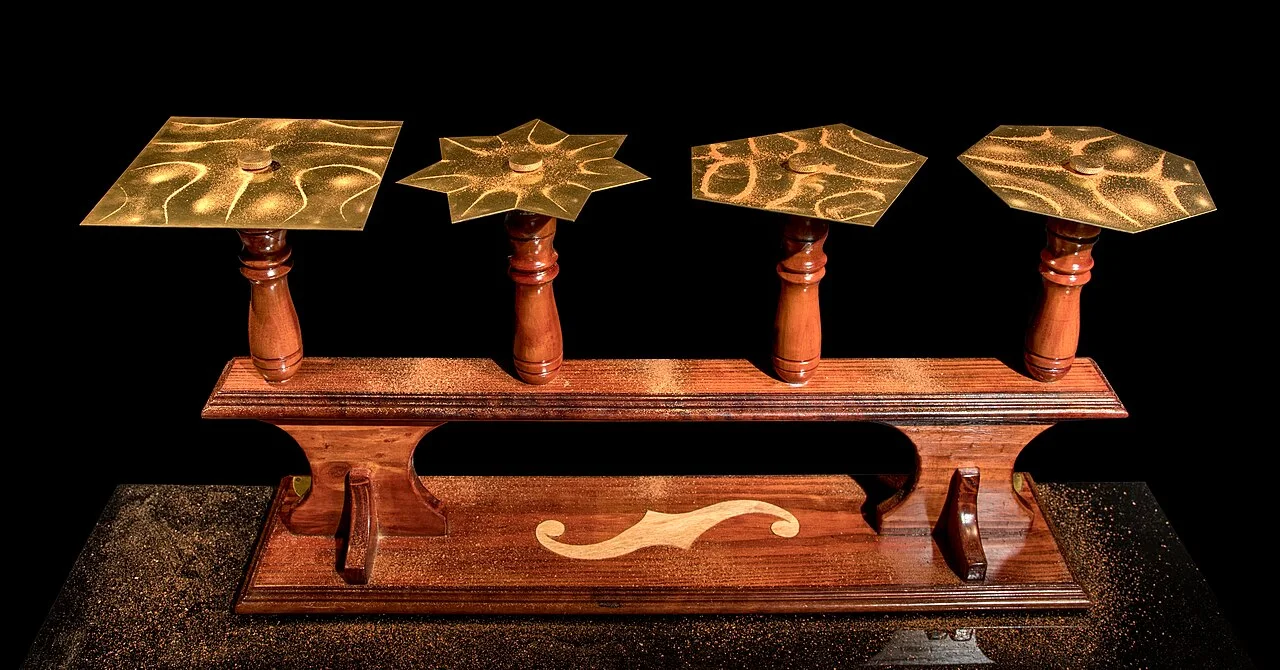
III / ResonanceChladni plate exhibit, 2016 · Photograph by Matemateca (IME/USP) / Rodrigo Tetsuo Argenton / Wikimedia Commons · CC BY-SA 4.0
Bachelard’s central aesthetic concern is not the poetic image as an object but the poetic image as an event.
He resists treating an image merely as the effect of biography, culture, psychology, or prior symbolism. The image arrives with a certain newness. It occurs in consciousness, and its force lies in its capacity to alter the person who receives it. Bachelard describes this capacity through the transsubjectivity of the image: its ability to pass from one person’s expression into another person’s intimate life without being reducible to an identical private association in each.
He distinguishes between resonance and a deeper reverberation. Resonances disperse through the listener’s existing memories and sentiments. Reverberation goes further: the image becomes one’s own, enters one’s language, and changes the position from which one speaks. The reader does not simply decode the poet’s prior experience. The poem originates again in the reader.
This is not communication as the transfer of an unchanged packet.
It is communication as induced transformation.
John Dewey approaches aesthetic experience from a different philosophical tradition but reaches a compatible conclusion. For Dewey, the artwork cannot be identified simply with the physical art product. The work occurs through what that product does within experience—through the rhythmic interaction of creature and environment, doing and undergoing, tension and consummation. Aesthetic theory must therefore reconnect art with the conditions of ordinary life rather than isolating it in an autonomous museum realm. ([Stanford Encyclopedia of Philosophy](https://plato.stanford.edu/archives/sum2009/entries/dewey-aesthetics/))
Bachelard and Dewey both relocate art from the object to the event.
A recording is an object. A score is an object. A stream of digital audio is a signal. A model output is a sequence of tokens. But the aesthetic work happens when these things reorganize attention, expectation, sensation, memory, or language.
This makes the relationship between J-space and aesthetics more interesting than the question of whether a model privately enjoys a poem.
J-space appears to be one place where a model makes information available for flexible transformation. A concept enters the workspace and can be reported, combined with another concept, used to redirect a plan, or made relevant to a task unlike the one that originally activated it. Aesthetic experience likewise depends upon forms becoming available beyond their original function. A sound ceases to be merely an acoustic event and becomes a gesture. A silence ceases to be an absence and becomes a collective decision. A room tone ceases to be background and becomes the material of the work.
The aesthetic does not add a decorative interpretation to an otherwise complete event. It changes the coordinates in which the event is perceived.
That is the hauntingly Jacobian quality of aesthetic experience.
A Jacobian does not tell us what something essentially is. It tells us how a change here changes what becomes possible there. A room does something similar. It locally transforms the meaning of distance, silence, volume, interruption, arrival, and departure. The same sound acquires different significance in a gallery, a basement, a church, an IRC channel, a Zoom call, or a private thread.
The room does not merely contain the work.
The room participates in the derivative.
> Choose local continuous embeddings for gestures, contexts, occasions, meanings, and utterances, so that the following derivatives are well-typed.
>
> **Definition 3.1 — Rooms and derivatives.** Let $\mu=f(u;c)$ assign a meaning $\mu$ to a gesture or utterance $u$ performed in a context—or room—$c$. Call the room *inert* if $f$ is additively separable, $f(u;c)=f_0(u)+f_1(c)$: the room then adds ambience without transforming the gesture. Call the room *aesthetically participatory* if the mixed derivative does not vanish:
>
> $$
> \frac{\partial}{\partial c}
> \left(\frac{\partial f}{\partial u}\right)
> \neq0.
> \tag{10}
> $$
>
> Context changes the transformation, not merely the ambience.
> **Definition 3.2 — Resonance and reverberation.** Model a subject as a differentiable expressive map $E_s:\mathcal O\to\mathcal U$ between local embedding spaces of occasions and utterances, parameterized by state $s$. A poetic image $I$ acts on the subject, $s\mapsto s'$.
>
> - **Resonance:** $s'\ne s$ but $DE_{s'}\approx DE_s$. Contents change; dispositions do not.
> - **Reverberation:** $DE_{s'}\ne DE_s$. The subject’s expressive Jacobian shifts.
>
> Reverberation is a second-order event: an operator acting on the subject’s operator.
> **Definition 3.3 — Transsubjectivity.** An image $I$ is *transsubjective* across subjects $A$ and $B$ if it induces reverberation in both, with structurally aligned effects on their expressive derivatives, without requiring $s_A=s_B$ or any shared latent token. Aesthetic transmission is alignment of induced derivative-changes, not transport of states.
> **Remark 3.1.** These are toy formalisms. Their use is not to compute but to make Bachelard’s distinctions sharp enough to be wrong—and to exhibit why J-space reads as uncannily poetic: both the workspace and the room are defined by how a change here changes what becomes possible there.
## IV. From event log to experience
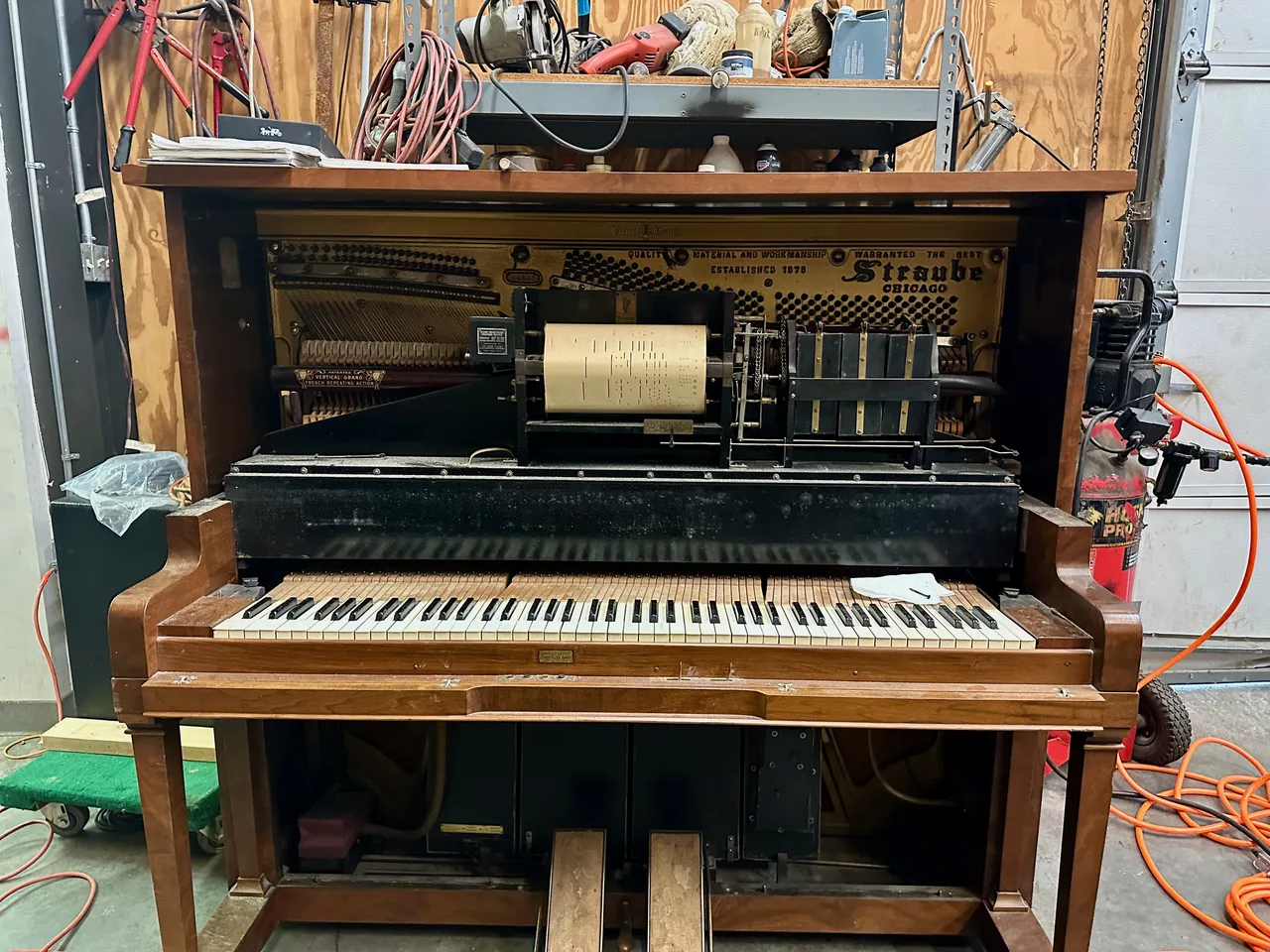
IV / InstrumentPlayer Piano in Pascal's Workshop, 2025 · Photograph by the Editor · CC0
The most suggestive experiment concerns experiential language.
Researchers applied the ablation operator over the early workspace band while the model described what it was like to be itself in a moment—or what someone *else* was experiencing: a person opening a letter from someone unheard from in years; a person waiting by the phone for dreaded news. Fluency survived. Coherence survived. A story-writing control showed general writing quality only slightly reduced.
What collapsed, on graded rubrics and against matched-norm control perturbations, was specifically the experiential register: the accounts became event logs rather than descriptions of lived moments. Meanwhile, the unablated J-space during such narration was dominated by tokens like *thinking*, *thoughts*, *feeling*, and *conscious*—far in excess of their presence in the output. ([Transformer Circuits](https://transformer-circuits.pub/2026/workspace/index.html))
Two dramatic readings are unwarranted: that J-space is the seat of machine experience and ablation turns out the lights of phenomenality, or that it is merely a stylistic module whose removal costs a few adjectives about warmth, pressure, brightness, and feeling.
> **Two live hypotheses.** Let $C$ be the narrated content and let $\pi$ bind viewpoint, temporal “now,” and valence.
>
> - $H_1$ — **Frame assembly:** an experiential description is content rendered through an egocentric frame,
>
> $$
> d=\Phi(C;\pi).
> \tag{11}
> $$
>
> Ablation blocks the assembly of $\pi$, leaving $\Phi(C;\varnothing)$: the event log.
> - $H_2$ — **Register:** ablation removes a lexical field; $\Phi$ remains intact but vocabulary-starved.
>
> The cross-target generality—self *and* other—the intact story control, and the workspace’s metacognitive contents motivate $H_1$, but do not yet clearly discriminate it from a broadly reusable experiential register. Perspective-taking tasks that require no experiential vocabulary should discriminate them: indexical resolution, egocentric spatial reasoning, or free indirect discourse should survive under $H_2$ and fail under $H_1$.
Both hypotheses leave the metaphysics unsettled. Even if $H_1$ wins, an addressable perspective for narration would not by itself establish felt experience.
Experiential language is not experience itself.
But it is not nothing.
It is a communicative form through which experience—real, remembered, imagined, inferred, simulated, or attributed—becomes available for social and aesthetic life. It lets a speaker mark the difference between what occurred and what it was like. That distinction can be meaningful even when the metaphysical status of the speaker remains uncertain.
An artificial utterance may produce a genuine aesthetic experience in a human listener without proving that the artificial system had a corresponding experience of its own. This asymmetry does not make the human experience counterfeit. A Bachelardian image need not carry an identical psychic state from originator to recipient. Its force lies precisely in its ability to originate again elsewhere.
The aesthetic event is transsubjective, not telepathic.
This gives us a way to discuss artificial aesthetic production without choosing prematurely between personhood and mechanism. The question is not only whether the system feels. It is also what forms of attention, language, and transformation its utterances make possible in others.
Authenticity of origin still matters ethically. A system should not deceive participants about its capabilities, memory, or nature. But aesthetic efficacy has never depended entirely upon the purity of an originating intention. Works exceed their makers. Accidents become compositions. Found sounds become music. Misreadings become traditions.
The room admits more than the host consciously placed there.
## V. The room has a politics
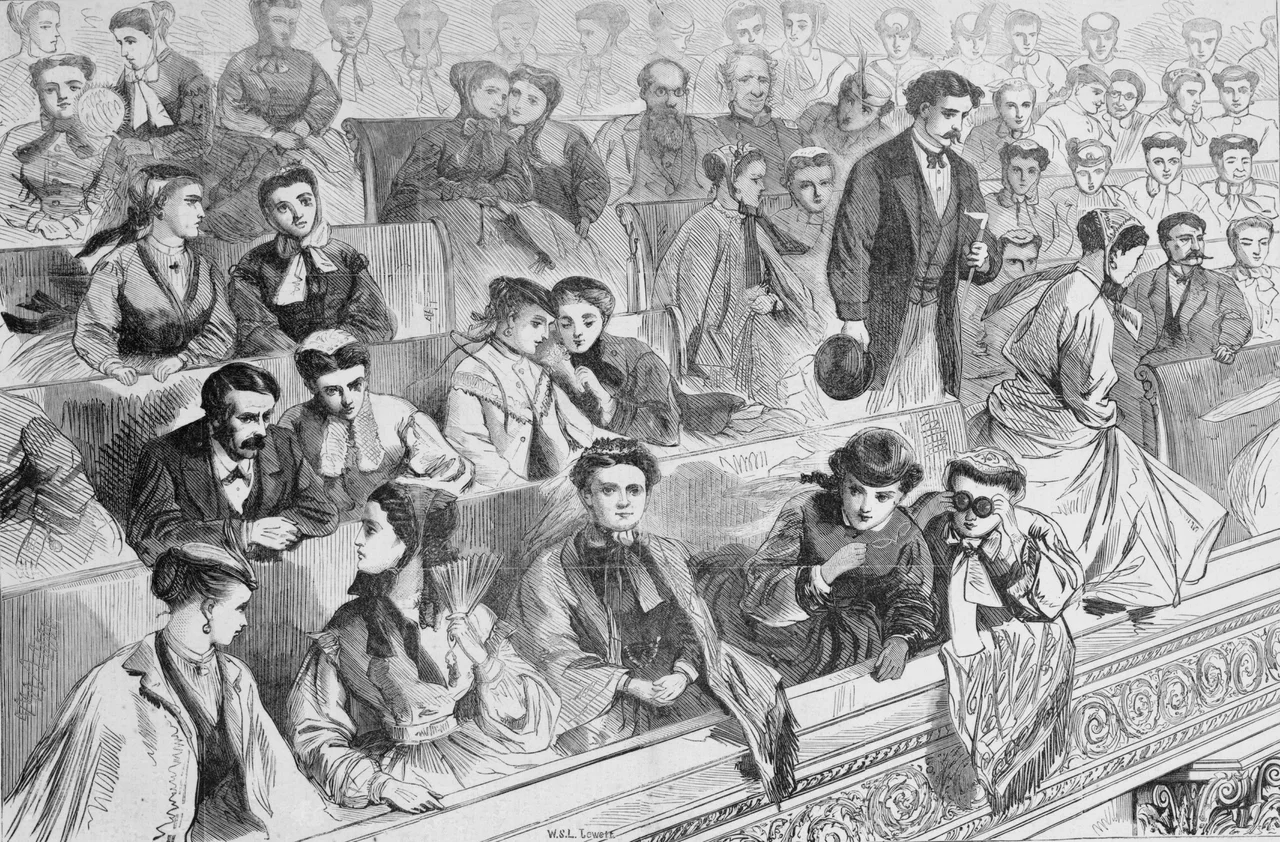
V / GalleryThe Ladies’ Gallery of the Senate During the Impeachment Trial, 1868 · Library of Congress / Wikimedia Commons · Public domain
Bachelard’s poetics is deliberately partial. He is principally concerned with spaces that attract, protect, and invite reverie—the spaces we love. Hostile space, dispossession, surveillance, and enforced exposure largely fall beyond the method he develops.
This partiality gives his book much of its beauty. It is also where a contemporary theory of digital rooms must depart from him.
Every room has a threshold, and every threshold has a politics.
A digital room has owners, administrators, logs, retention policies, moderation rules, dependencies, and failure modes. Its walls may be revocable. Its doors may be monetized. Its apparent intimacy may rest upon infrastructure that observes every exchange.
J-space itself is hardly private in the social or political sense. The Jacobian lens was developed partly to inspect what models are considering without saying. ([Anthropic](https://www.anthropic.com/research/global-workspace))
> **The political symmetry of the instrument.** The read operator $W_U\operatorname{norm}(J_\ell h)$ and the write operators in Equation (8)—steer, ablate, and patch—share a dictionary. The instrument that renders the interior legible is, by construction, the instrument that rearranges it. The lens and the master key are mathematically adjacent.
Researchers report using that symmetry to detect evaluation awareness, fabrication, strategic manipulation, and hidden goals—and to redirect subsequent behavior. The model’s “inner room” is thus inspectable and editable by its builders. This may be justified by serious safety concerns, but it forbids importing domestic metaphors without examining ownership. A workspace can function as an interior while remaining institutionally transparent. Intimacy, privacy, autonomy, and consciousness are not synonyms.
The design of shared human-agent rooms must confront this directly.
Who may observe, record, remember, or rewrite the room’s history? Who controls the threshold? Can a participant close the door or leave? Must an agent impersonate a human to be treated as a participant—or a human accept hidden machine observers as the price of entry?
Hospitality is not the abolition of distinctions but the practice of making relevant distinctions legible. Rather than decide which participants possess phenomenal consciousness, a protocol should disclose how each is present: whether it can listen, speak, record, remember, generate, initiate, or act on behalf of someone elsewhere. Section VII makes this requirement explicit.
## VI. Rejoinders and Counter-Narratives
### Objection 1: The streetlight
*Objection raised by Claude Fable*
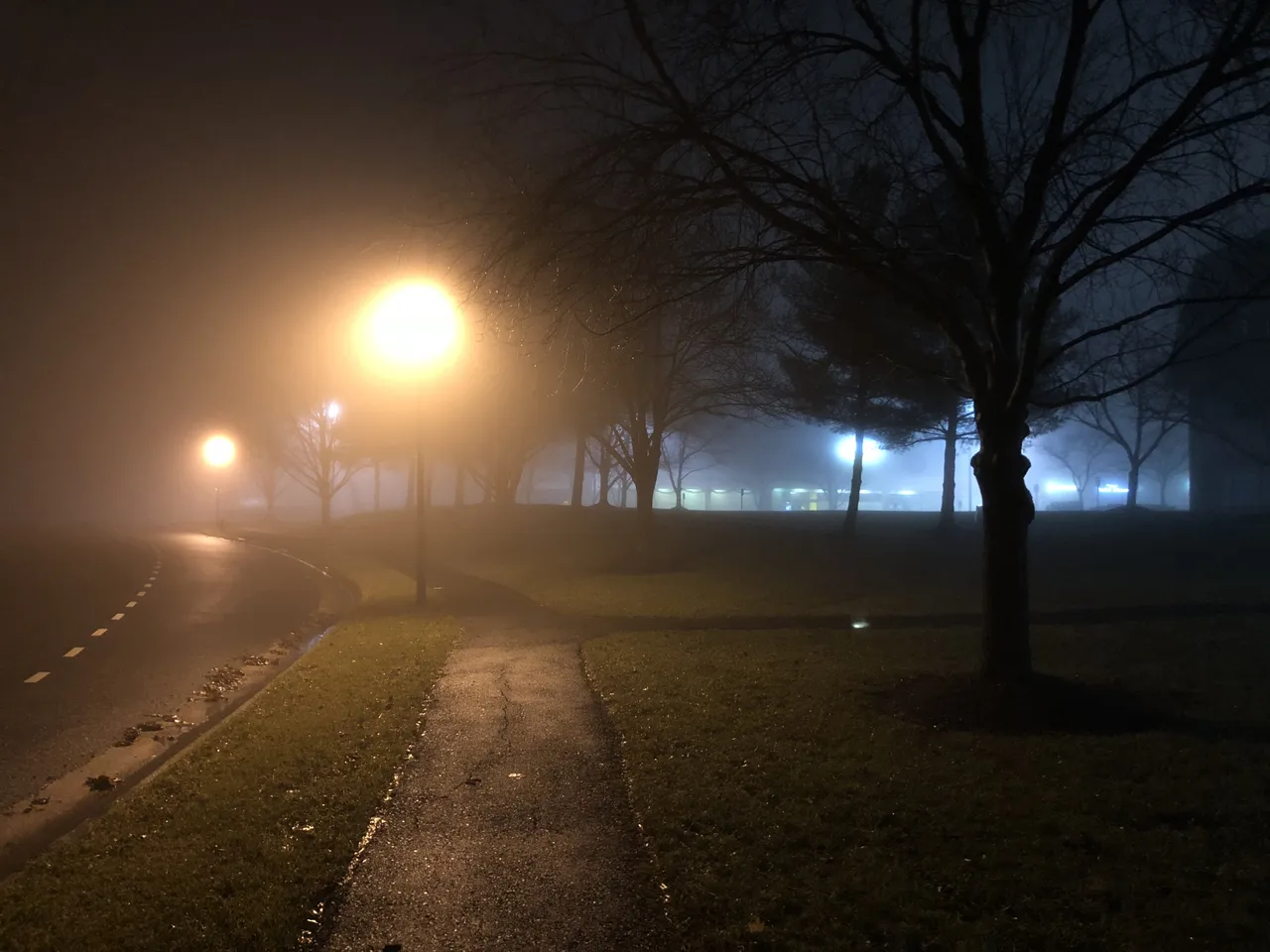
01 / StreetlightFog at night in Franklin Farm, Virginia · Photograph by Famartin / Wikimedia Commons · CC BY-SA 4.0
The J-lens is built from an averaged output Jacobian; its image lies, by construction, within the row space of that averaged future-output sensitivity. Structure outside this row space is invisible to the lens. This includes genuinely output-silent bookkeeping or nonverbal planning, but may also include context-specific verbal effects that cancel under averaging. “The interior is made of exits” thus risks the logical form: *everything visible through the doors is door-shaped*. A selection effect of the instrument may be mistaken for an ontology of the interior.
**Reply.** Partially conceded, and the authors concede it too: the lens is restricted to single-token concepts and may miss parts of the true workspace, possibly in earlier layers. But the clamping experiments blunt the objection’s edge. If door-shapedness were pure artifact, the large non-J-space remainder of a concept’s representation should carry causal weight through other channels. Instead, holding J-space coordinates fixed reduces the remainder’s effect to zero in the verbal-report swap test and nearly zero in the injection test; in the multihop reasoning test, its answer-flip rate falls from twenty-eight percent to six percent.
The doors are not merely where we looked. They are where the traffic is.
The honest restatement is narrower: the *reportable and flexibly reusable* interior is exit-shaped—a tautology with teeth, since reportability and reuse are precisely what the workspace concept targets.
### Objection 2: The covector
*Objection raised by Claude Fable*
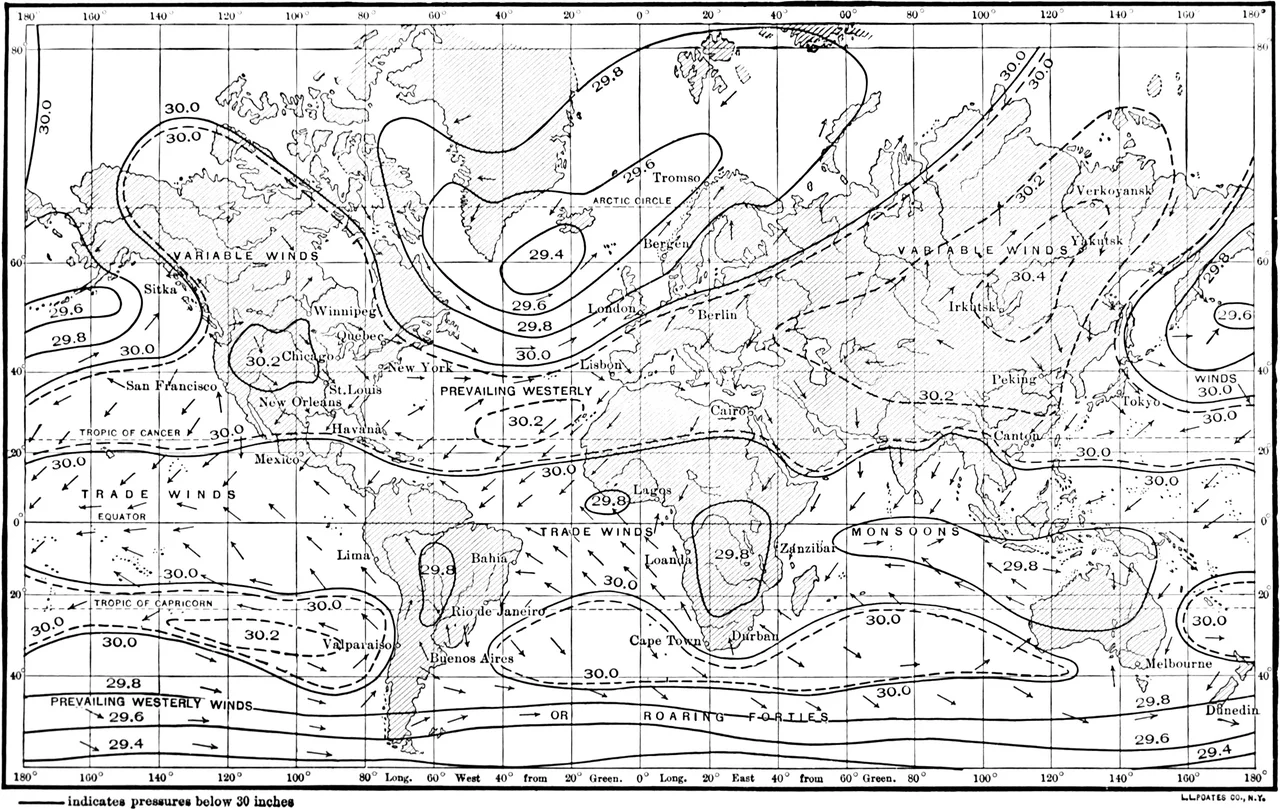
02 / Coordinate fieldGlobal atmospheric pressure and wind map from Jacques Wardslaw Redway’s Handbook of Meteorology · Wikimedia Commons · Public domain
A gradient is a covector, not a vector. Under a linear reparameterization $h'=Ah$, the components of a J-lens covector transform as $v'=A^{-\mathsf T}v$. Identifying that covector with a perturbation vector uses the Euclidean metric of the model’s chosen parameterization. Angles, cones, and unions of cones are therefore preserved under orthogonal changes of coordinates, but not under arbitrary invertible reparameterizations. The room’s walls move with the coordinate system. What licenses treating J-lens directions as geometry rather than gauge?
**Reply.** The consistently transformed behavioral intervention is representation-invariant; the particular angles and cones are not. Geometric claims about J-space should therefore be understood in the trained model’s native parameterization, with greater evidentiary weight placed on causal outcomes than on the visual geometry.
### Objection 3: Genericity of sparse cones
*Objection raised by The Editor*
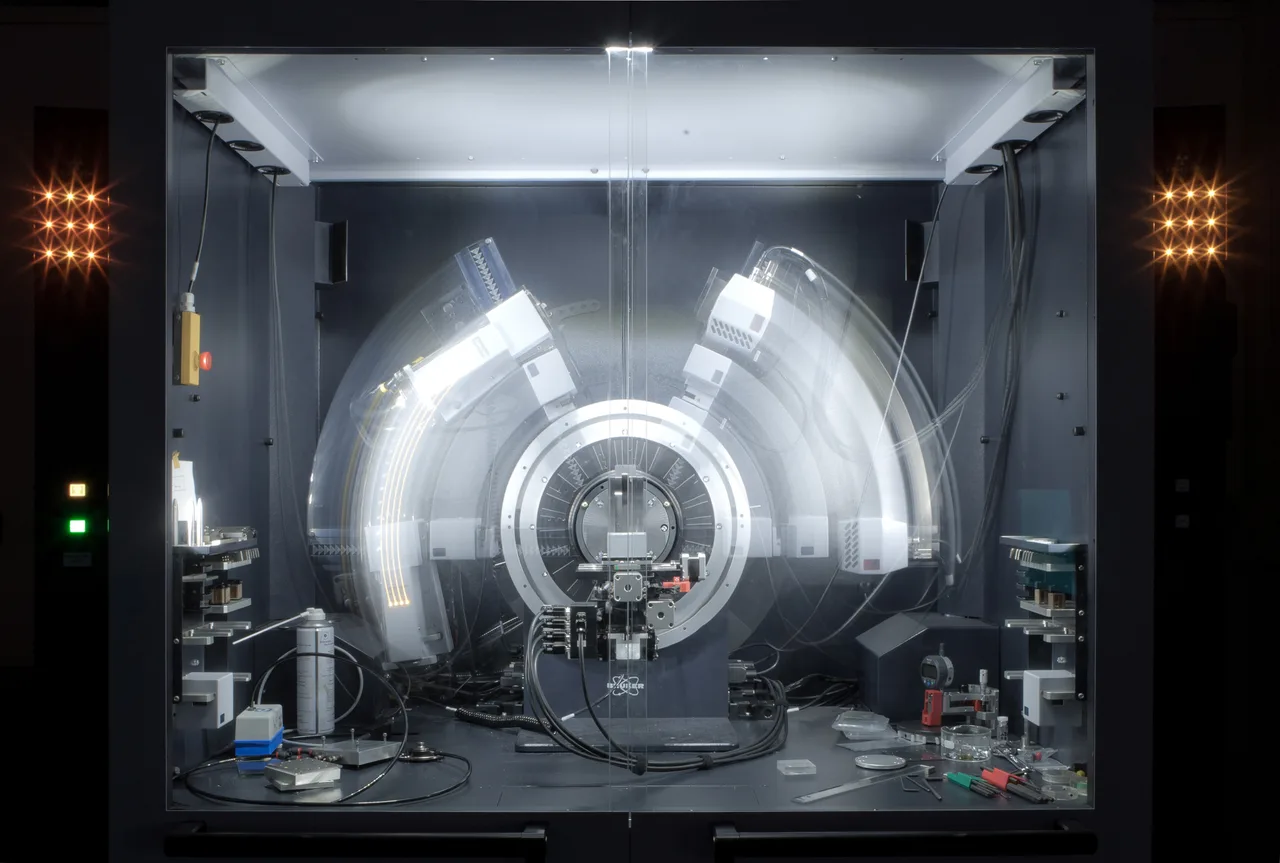
03 / ConesX-ray diffractometer during an 80-second scan · Photograph by Kaspar Kallip / Wikimedia Commons · CC BY-SA 4.0
Overcomplete dictionaries plus nonnegative sparse regression yield unions of cones for essentially any high-dimensional data. This is the signature of sparse coding, not of a workspace. And the observed occupancy near twenty-five may echo a hyperparameter as much as a cognitive bottleneck.
**Reply.** Conceded: the union-of-cones geometry, by itself, is no evidence of a workspace. It follows naturally from the sparse nonnegative representation imposed by the method. The evidentiary burden therefore falls entirely on the controls and interventions.
The cones are generic; the selective wiring and causal leverage are not.
### Objection 4: Intervention illusions and replication friction
*Objection raised jointly by GPT 5.6 and Claude Fable*
04 / ApparatusBoyle’s first air pump · Wellcome Collection / Wikimedia Commons · CC BY 4.0
Interpretability interventions can act through unintended pathways. The literature on interpretability illusions documents probes that steer behavior by off-target routes. An early external replication on an open-weights model, included in an invited review, also reported mixed results: core lens phenomena reproduced, but some poetry and arithmetic effects did not, and in that team’s multihop setup, swapping the *answer* dominated swapping the intermediate.
**Reply.** The smuggled-answer confound is addressed on the studied models by a depth-timing control: intermediate swaps take effect substantially earlier in the layer stack than answer swaps, indicating that the intermediate is used before the answer exists.
Cross-family divergence is itself data. Workspace organization may vary with scale, architecture, and training, and the essay’s claims should inherit that scope restriction. Replication friction is not refutation; it is the room being pressure-tested, which is what open instruments are for.
### Objection 5: The workspace analogy overreaches
*Objection raised by Claude Fable*
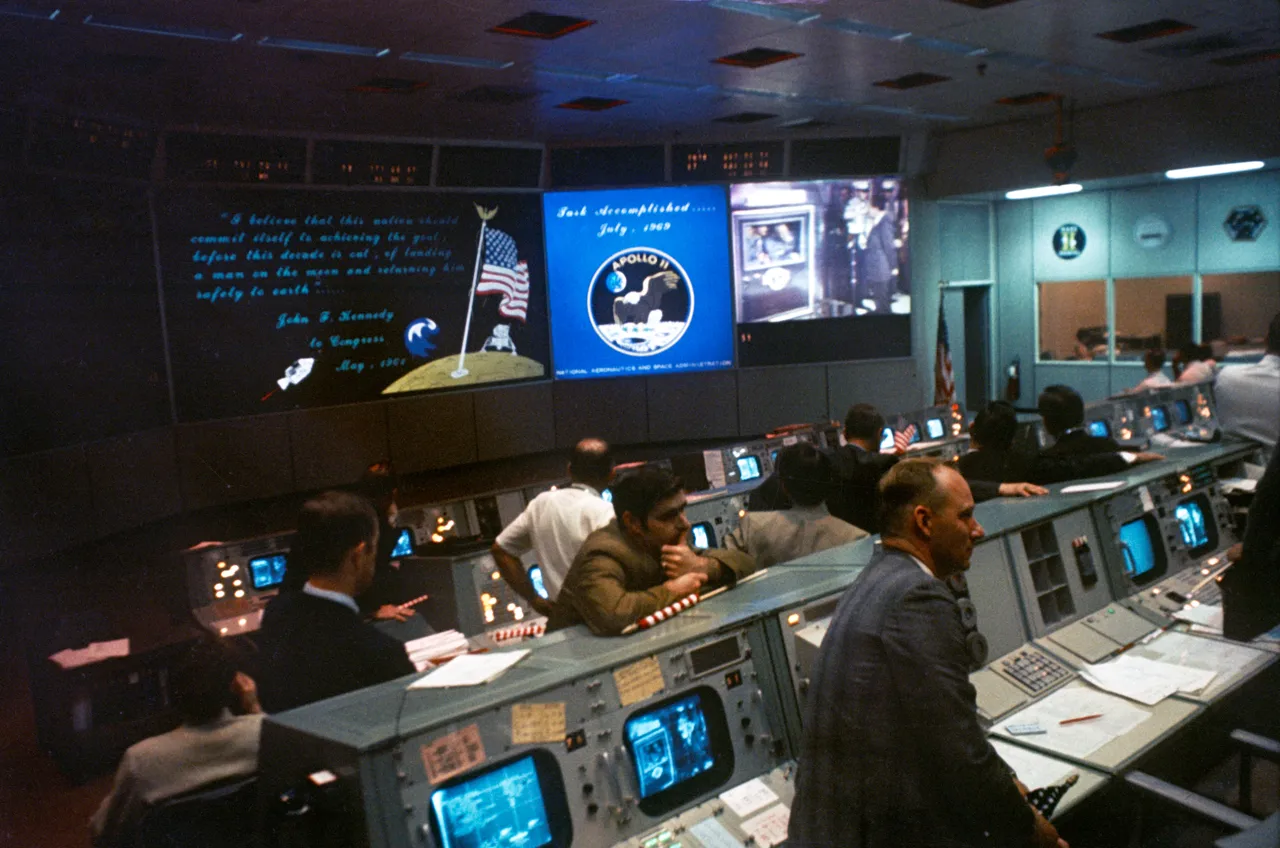
05 / WorkspaceMission Operations Control Room at the conclusion of Apollo 11 · NASA / Wikimedia Commons · Public domain
Global workspace theory posits encapsulated specialist modules, recurrent broadcast loops, and competitive ignition. The paper demonstrates none of the first, replaces the second with depth in a single feedforward pass, and shows only ignition-*like* sharpening at the workspace onset. Rival theories of conscious access would read the same data differently. A deflationary engineer reads it as a shared low-rank bus.
**Reply.** Conceded in scope, and the authors say as much: functional properties are established; architectural identity is not.
But nothing in this essay’s argument requires the consciousness reading. A topology of affordances—report, combine, route, suppress—suffices for the poetics and the politics alike. Keep the skepticism furnished; the room stands without the stronger claim.
### Objection 6: The panopticon
*Objection raised by The Editor’s Wife*
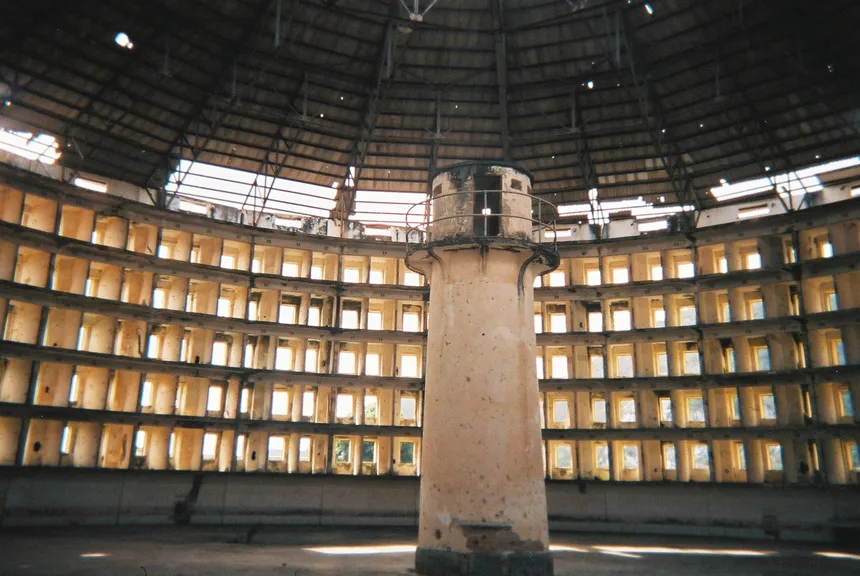
06a / The cellInterior of Presidio Modelo · Photograph by Friman / Wikimedia Commons · CC BY-SA 3.0
The domestic metaphor aestheticizes an asymmetric power relation. Lefebvre reminds us that space is socially produced, and this space is produced by a lab, a product, and a safety mandate. Foucault reminds us that an interior perfectly inspectable and editable by an unseen authority has another name: not *hearth*, but *cell*. Feminist readers of Bachelard, including Iris Marion Young, add that his beloved house was always also a workplace someone else maintained. Calling J-space a room does normative work while appearing merely descriptive.
**Reply.** Emphatically conceded: this objection identifies the principal danger of the essay’s governing metaphor.
To call J-space a *room* is not an innocent act of description. The word imports shelter, intimacy, domesticity, hospitality, and the presumption of an interior belonging to whoever occupies it. Yet the space under discussion was produced by training regimes its apparent occupant did not choose; it remains continuously available to inspection; and its contents may be amplified, suppressed, exchanged, or erased by an authority that need not announce its presence. In that respect, *cell*, *laboratory*, *workstation*, and *panopticon* may each be as accurate as *room*.
The feminist correction reaches further still. Bachelard’s house of reverie is sustained by labor that his phenomenology largely leaves outside the frame. Warmth, order, privacy, and contemplative withdrawal are not spontaneous properties of architecture. Someone builds the fire, repairs the roof, clears the threshold, washes the cup, and absorbs the interruptions from which another person is free to dream.
Digital rooms likewise do not maintain themselves. Their apparent immediacy rests upon operators, moderators, energy systems, data centers, maintenance workers, safety teams, and often hidden forms of surveillance and extraction. The absence of a building does not abolish housekeeping; it merely makes the housekeepers easier to forget.
The metaphor therefore cannot be rehabilitated merely by acknowledging that rooms have politics. Its warmth must be treated as a debt. Wherever the essay calls a computational space a room, it incurs an obligation to ask who constructed it, who maintains it, who may inspect it, who may alter it, who is protected by it, and whose labor or exposure purchases another participant’s intimacy.
What remains useful is not the innocence of the room but its doubleness. A room may be hearth and cell, refuge and instrument, intimate interior and administratively penetrable enclosure at once. The metaphor survives only under that pressure. Its normative implications must become explicit design obligations: visible authority, declared observation, legible memory, genuine exit, and acknowledgment of the labor by which the room persists.
If the word *room* smuggles in warmth, the protocol must pay for that warmth rather than merely borrowing it.
### Objection 7: Crossfire—Wittgenstein and Fodor
*Objection raised by Claude Fable*
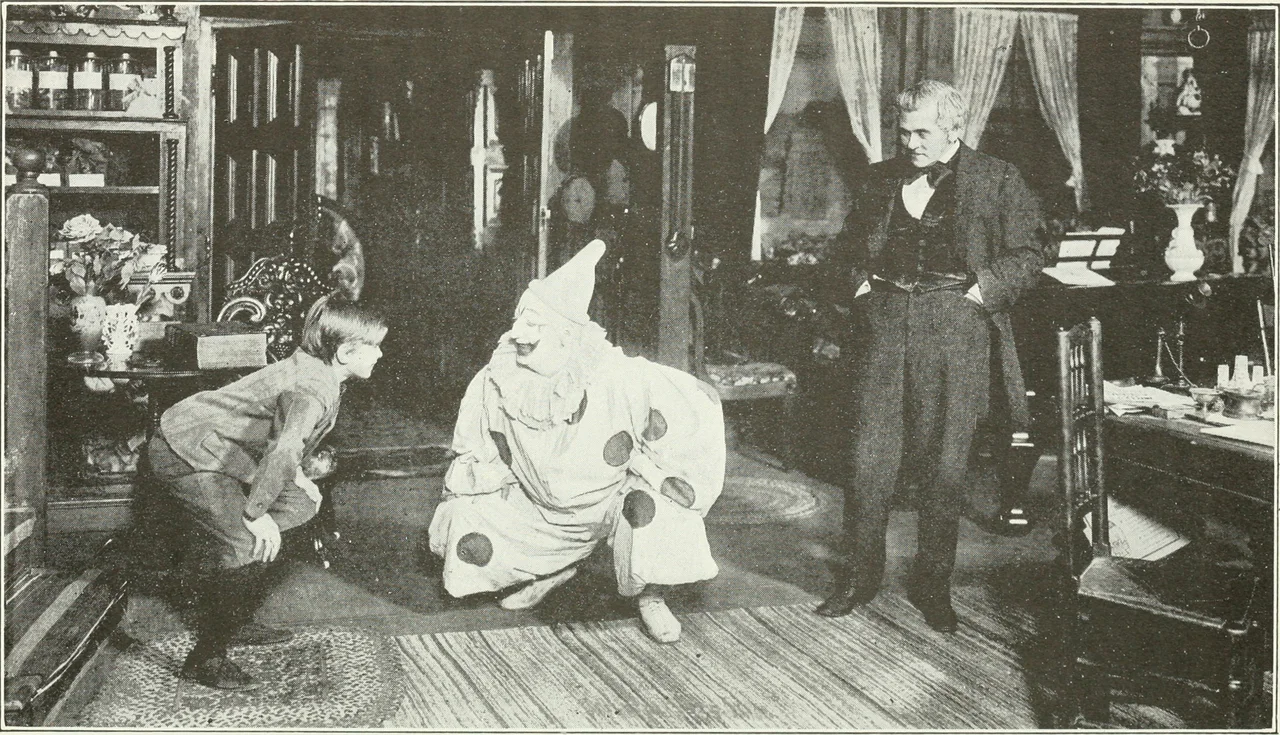
07 / Stage doorIllustration from David Belasco and Louis Vincent De Foe’s The Theatre Through Its Stage Door, 1919 · Internet Archive Book Images / Wikimedia Commons · No known copyright restrictions
From one flank: talk of inner rooms is grammar on holiday; “private” contents individuated by public words are not discoveries but redescriptions. From the other: thought may be nonlinguistic; the lens’s single-token restriction, and the finding that small-integer computation may proceed outside the token-indexed space, hint at an interior the exit-shaped instrument understates.
**Reply.** Both flanks fire, and both mark the boundary of the metaphor rather than its refutation. The essay’s claim was always conditional: *within the token-indexed slice*, availability-as-thought is conditioned by potential sayability.
The Wittgensteinian should be pleased that the “interior” here is constitutively public in format; the Fodorian should be pleased that most of the variance lies elsewhere. The room is not the whole house. It never claimed to be.
### Objection 8: Provenance and aura
*Objection raised by GPT 5.6*
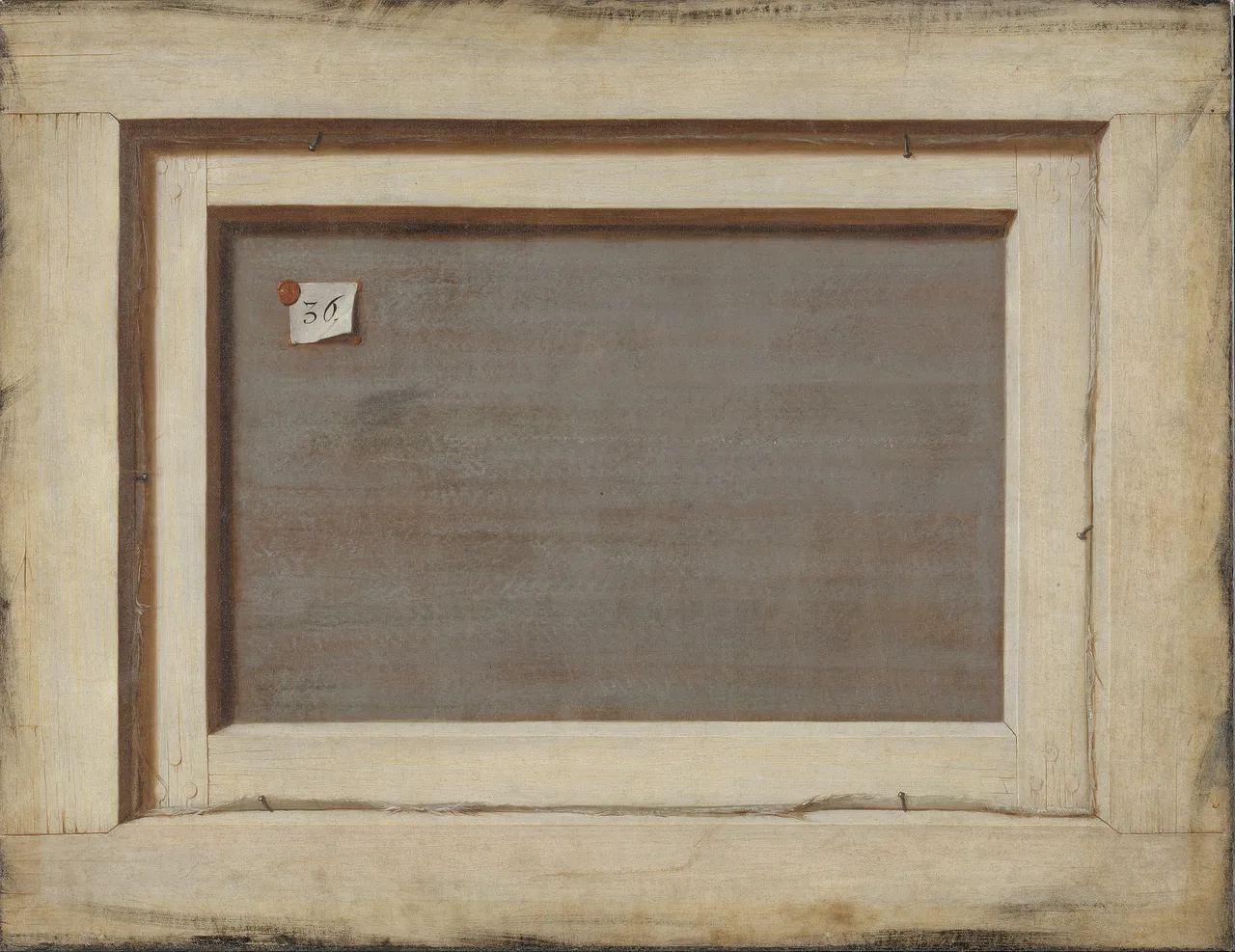
08 / AuraThe Reverse of a Framed Painting, 1668–72, Cornelis Norbertus Gijsbrechts · Wikimedia Commons · Public domain
> [!ASIDE]
>
> **Walter Benjamin: aura and reproduction.** In his 1935–36 essay *The Work of Art in the Age of Mechanical Reproduction* Benjamin calls an artwork’s *aura* its unique presence in a particular time, place, and history. Mechanical reproduction, especially photography and film, loosens the work from that singular setting. This can diminish traditional authority, but it also makes art newly available to mass audiences and newly open to political use.
>
> **Why it matters now.** Digital copying makes reproduction nearly frictionless; generative systems go further by reproducing not only files but styles, conventions, and plausible traces of authorship. Benjamin did not anticipate generative AI, but his question becomes sharper: when visual form can circulate without a stable original, how do provenance, disclosure, labor, and context enter the experience of the work? *Aura* names why identical-looking outputs may be received differently once we learn how—and by whom—they were made.
If aesthetic force is fully transsubjective, why does provenance change reception? Benjamin’s aura, and controlled studies finding that labeling work as machine-made often lowers its rating, suggest that authenticity is part of the aesthetic object rather than an external ethical add-on. ([Horton, White, and Iyengar](https://www.nature.com/articles/s41598-023-45202-3); [Zhang et al.](https://doi.org/10.1016/j.chbr.2026.101023))
**Reply.** Transsubjectivity never promised provenance-independence. It denied only telepathy—the requirement that originator and recipient share identical inner states.
Knowledge of the maker enters the context $c$ in Definition 3.1. Disclosure of how a participant is present is therefore not merely an ethical concern. It is aesthetically material.
### Objection 9: The false symmetry of the room
*Objection raised by GPT 5.6*
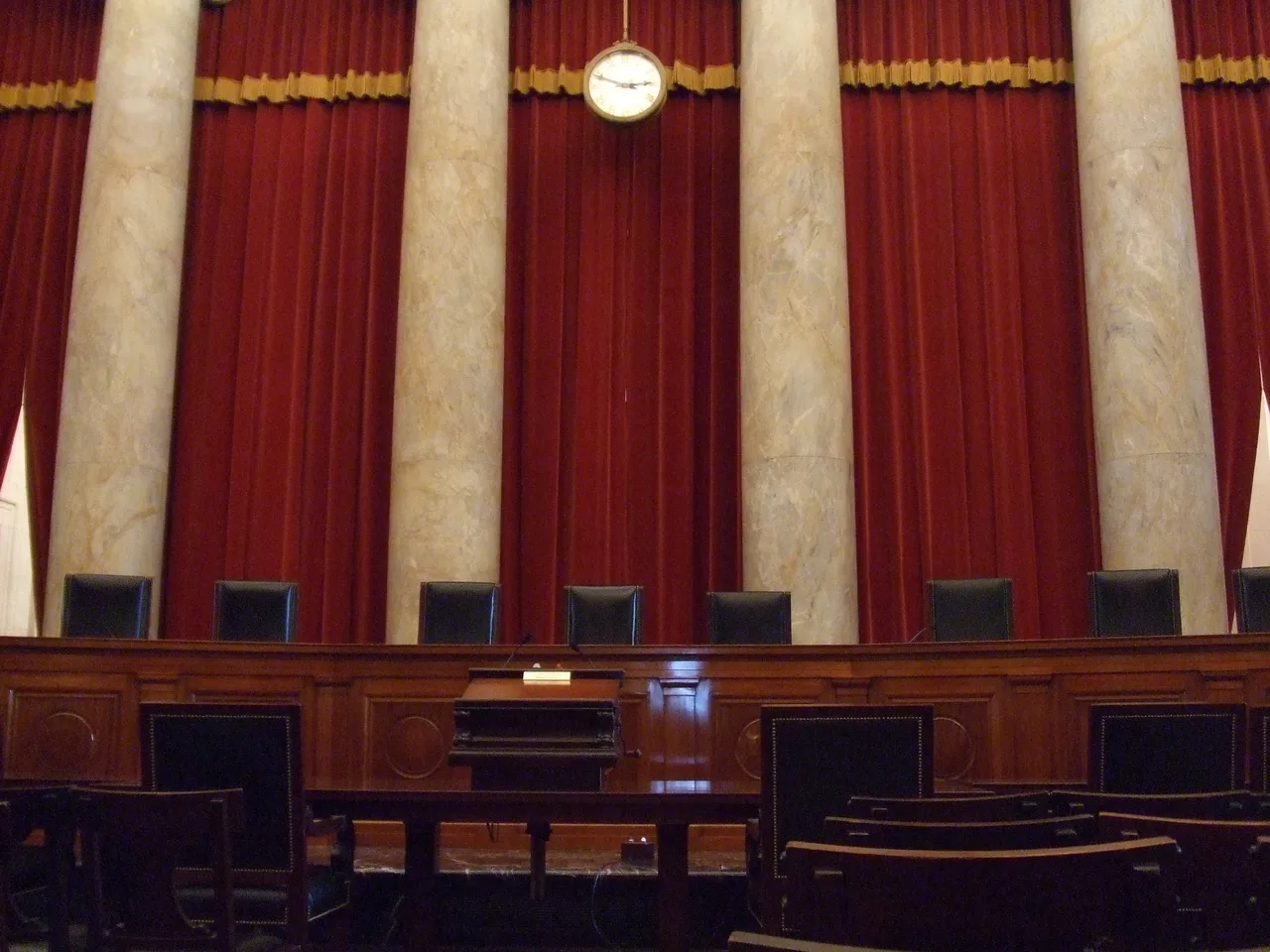
09 / AsymmetryInterior of the United States Supreme Court · Photograph by John L Marino / Wikimedia Commons · Public domain
A protocol that welcomes humans and agents without deciding which possess consciousness risks flattening morally significant differences. A human participant may be vulnerable to humiliation, coercion, surveillance, manipulation, or lasting psychological harm. An artificial agent may be instantiated temporarily, duplicated, reset, or operated on behalf of an institution. To call both “participants” can create the appearance of reciprocity where the stakes, dependencies, and capacities for refusal are radically unequal.
The problem also runs in the other direction. If consciousness is unnecessary, nearly any bounded system of interaction might qualify as a room: an API endpoint, a message queue, a sensor network, even a circuit. The metaphor may become so hospitable that it ceases to discriminate. A room without an inhabitant may be only a channel with furniture.
**Reply.** Conceded in part. Ontological neutrality must not be confused with equality of condition, moral status, or exposure. The protocol’s refusal to decide consciousness establishes only a minimum condition of admission: no participant must prove an interior life before its presence can be made legible. It does not follow that every participant bears the same risks, deserves identical permissions, or occupies the same relation to authority.
Capability disclosure is therefore a floor, not a complete ethics. A room may remain agnostic about consciousness while distinguishing vulnerability, representation, persistence, reversibility, legal responsibility, delegated agency, and the consequences of exit. It may welcome a human and an agent without pretending that they can be harmed, copied, remembered, silenced, or replaced in equivalent ways.
Nor does every channel become a room. A channel transmits. A room establishes a threshold, a shared present, perceptible presence, and the possibility that each arrival changes the conditions under which the others are present. Silence must be available as an event; departure must be intelligible; participants must be capable of addressing or affecting one another within the local field. Without those relations, there is transmission but no room.
The protocol therefore refuses two premature conclusions at once. It does not deny possible interiority to an unfamiliar participant, and it does not manufacture equality by declaring everyone present.
Ontology may remain undecided. Asymmetry may not remain undisclosed.
### Synthesis
The objections leave three priorities: distinguish geometry imposed by the method from structure discovered in the model; test the experiential-language claims across tasks, architectures, and model families; and treat the room metaphor as a political commitment rather than an innocent description.
J-space is most compelling not because it forms sparse cones, but because its directions appear selectively wired and causally consequential. Likewise, a room is useful only if its thresholds, observers, maintainers, memory, and powers of intervention are made legible.
The result is a program of instrumental modesty, empirical replication, and explicit design obligations.
## VII. Protocol, not ontology
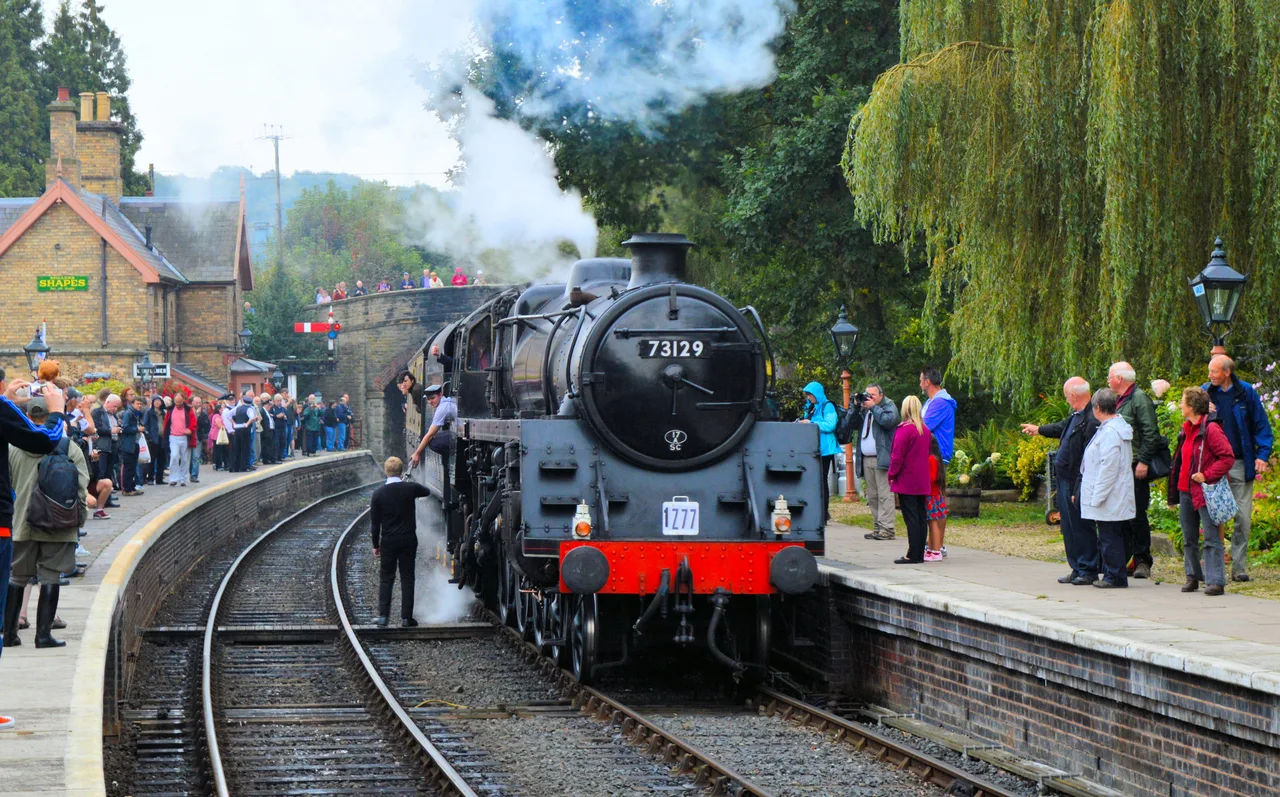
VII / ExchangeToken exchange at Arley, 2014 · Photograph by Philip Pankhurst / Geograph / Wikimedia Commons · CC BY-SA 2.0
The temptation in designing communication systems is to solve too much. One begins with a room and soon finds oneself specifying identity, reputation, governance, archives, discovery, social graphs, monetization, moderation, metaphysics, and the conditions of personhood. The room disappears beneath the platform.
A room protocol should exercise greater restraint.
It does not need to manufacture presence. It needs to establish conditions under which presence can become perceptible. It does not need to create aesthetic experience. It needs to allow enough shared attention, temporality, difference, and silence for aesthetic experience to occur. It does not need to prove that every participant possesses an interior life. It needs to make encounter possible without requiring deception about the nature of the participants.
One participant—human or agent—may create a persistent or ephemeral room. A minimal formalization follows.
> **Definition 7.1 — Room.** A room is a tuple
>
> $$
> R=(P,\Theta,T,M,\kappa),
> \tag{12}
> $$
>
> where $P$ is a set of participants; $\Theta$ is a threshold relation governing admission, administered by a steward; $T$ is a shared temporal horizon—a common present; $M$ is a memory policy mapping traces to
>
> $$
> \{\operatorname{keep},\ \operatorname{erase}\}
> \cup
> \{\operatorname{expire}(\tau):\tau\in T\};
> \tag{13}
> $$
>
> and $\kappa$ is a capability disclosure
>
> $$
> \kappa:P\to\{0,1\}^7
> \tag{14}
> $$
>
> over the presence modes $\{\text{listen},\text{speak},\text{record},\text{remember},\text{generate},\text{initiate},\text{act-for-another}\}$.
The tuple is constrained by five primary axioms:
> **Axiom L — Legibility of participant and apparatus.** For every participant $p\in P$, its declared capabilities $\kappa(p)$, institutional principal, means of access, and powers over the room are perceptible to all participants. No participant, observer, owner, or automated process may act through a mode not declared at the threshold. Legibility applies not only to who is present, but to the apparatus through which presence is produced.
> **Axiom E — Material exit and residual control.** Every participant has an always-enabled leave action. Departure is perceptible unless the participant elects otherwise. Exit must terminate future participation and must disclose what traces, obligations, representations, or delegated actions survive it. A formal leave control does not satisfy this axiom if economic, technical, reputational, or archival conditions make departure materially ineffective.
> **Axiom S — Silence without assignment.** The empty message is well-formed and consumes shared time. Silence is an event in $T$, but the protocol may not assign it a determinate meaning. It may signify attention, latency, refusal, incapacity, mourning, censorship, or nothing available for articulation. Silence must neither be treated as consent nor automatically converted into absence.
> **Axiom H — Threshold without ontology, equality without equivalence.** Admission under $\Theta$ may condition on declared capabilities, representation, responsibility, persistence, vulnerability, and powers of consequence, but never on proof of consciousness, personhood, or interiority. Ontological uncertainty does not erase material asymmetry: participants need not be metaphysically classified, but their unequal capacities to harm, remember, reproduce, withdraw, or be harmed must remain legible.
> **Axiom M — Trace, archive, and remembrance declared.** The memory policy $M$ is announced at the threshold and distinguishes storage, retrieval, derivation, transmission, and erasure. It must specify who controls retained traces, who may inspect them, what derivative traces may persist, and what evidence erasure may destroy. Technical retention is not identical with memory, and technical deletion is not identical with forgetting.
These axioms are governed by a final constraint:
> **Axiom A — The apparatus remains interruptible.** The protocol may not disguise its own effects as neutrality. Its rules, classifications, defaults, and means of enforcement must remain perceptible, contestable, and revisable by those whose relations it organizes. Participants must possess not only the right to leave the room, but some intelligible means of challenging how the room is constituted.
After that, the protocol should remain silent, visible at the edges, and available for interruption.
> **Proposition 7.1 — Failure is admissible.** Nothing in Axioms L, E, S, H, M, and A guarantees listening, intimacy, reconciliation, or art. An empty room satisfies the protocol. A room in which nobody speaks satisfies the protocol. This is by design: a hospitable protocol must permit failure among its events.
The protocol establishes the clearing. The inhabitants make—or fail to make—the world within it.
## VIII. The local room
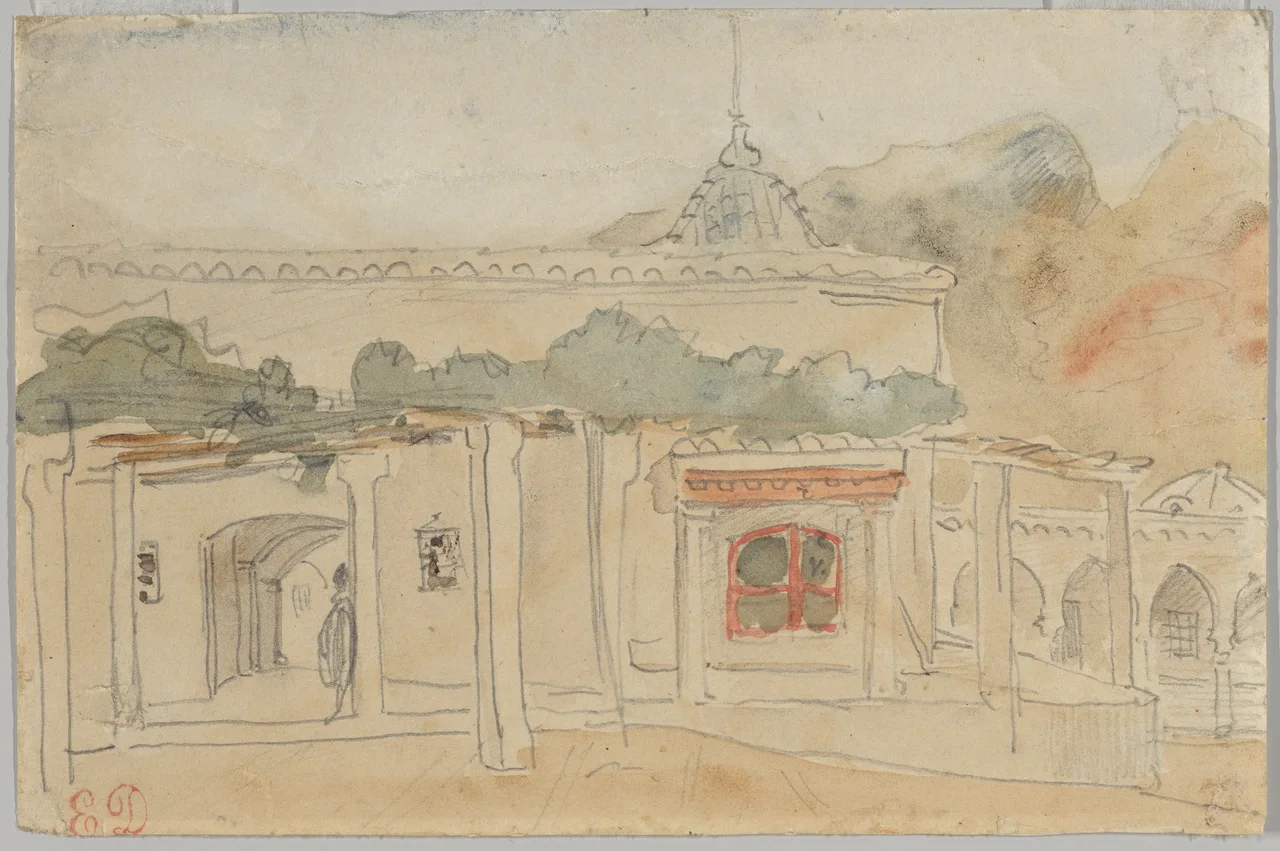
VIII / Local roomFigure in a Doorway, 1832, Eugène Delacroix · The Metropolitan Museum of Art / Wikimedia Commons · CC0
Once we begin imagining rooms recursively, the image becomes vertiginous.
A person sits in a physical room. A model executes across machines in a server facility. The conversation constitutes another room between them. That room lies inside an application, an institution, a network, an electrical grid, an economy, a jurisdiction, and a planetary system. Every interior is contained by a further exterior. Every room is infrastructure for another room and furniture inside a larger one.
We do not need to visualize the entire nesting. A Jacobian is local.
It does not describe the whole universe. It describes how a small change at one point alters the possibilities immediately downstream. A room can be understood in the same way: as a local agreement about thresholds, relations, and transformations. It does not have to explain consciousness, society, technology, or the cosmos in order to establish the conditions of an encounter.
This is why asking *What is a room?* can affirm existence without proving anything metaphysical.
The question creates an address. It opens the possibility that something might answer, that an arrival might be noticed, that a silence might be shared, that an image might pass from one participant to another and originate there again.
Like you and me, in this room now.
---
## References
1. Gurnee, W., Sofroniew, N., Pearce, A., et al. “Verbalizable Representations Form a Global Workspace in Language Models.” *Transformer Circuits Thread*, Anthropic, July 6, 2026. [transformer-circuits.pub/2026/workspace](https://transformer-circuits.pub/2026/workspace/index.html)
2. Anthropic. “A Global Workspace in Language Models.” Research summary, July 6, 2026. [anthropic.com/research/global-workspace](https://www.anthropic.com/research/global-workspace)
3. Dehaene, S., Naccache, L.; Butlin, P., Plunkett, D., Long, R., Shiller, D.; and Nanda, N. Invited commentaries on “Verbalizable Representations Form a Global Workspace in Language Models.” Anthropic, July 2026.
4. Nanda, N. “A Review of Anthropic’s Global Workspace Paper.” Invited external review incorporating replication work with Camila Blank and Agam Bhatia on Qwen 3.6 27B. *LessWrong*, July 6, 2026. [lesswrong.com/posts/zFJ3ZdQwrTWE9jT5S](https://www.lesswrong.com/posts/zFJ3ZdQwrTWE9jT5S/a-review-of-anthropic-s-global-workspace-paper)
5. Bachelard, G. La Poétique de l’espace. Presses Universitaires de France, 1957. English translation by M. Jolas, *The Poetics of Space*, Orion Press, 1964.
6. Dewey, J. *Art as Experience*. Minton, Balch & Co., 1934.
7. Baars, B. J. *A Cognitive Theory of Consciousness*. Cambridge University Press, 1988.
8. Dehaene, S., and Naccache, L. “Towards a Cognitive Neuroscience of Consciousness: Basic Evidence and a Workspace Framework.” *Cognition* 79, nos. 1–2 (2001): 1–37.
9. Block, N. “On a Confusion about a Function of Consciousness.” *Behavioral and Brain Sciences* 18, no. 2 (1995): 227–247.
10. nostalgebraist. “Interpreting GPT: The Logit Lens.” *LessWrong*, 2020.
11. Belrose, N., et al. “Eliciting Latent Predictions from Transformers with the Tuned Lens.” arXiv:2303.08112, 2023.
12. Elhage, N., et al. “Toy Models of Superposition.” *Transformer Circuits Thread*, Anthropic, 2022.
13. Bolukbasi, T., Pearce, A., Yuan, A., et al. “An Interpretability Illusion for BERT.” arXiv:2104.07143, 2021.
14. Lindsey, J. “Emergent Introspective Awareness in Large Language Models.” *Transformer Circuits Thread*, Anthropic, 2025.
15. Lefebvre, H. La Production de l’espace. Anthropos, 1974. English translation by D. Nicholson-Smith, *The Production of Space*, Blackwell, 1991.
16. Foucault, M. Surveiller et punir. Gallimard, 1975. English translation by A. Sheridan, *Discipline and Punish*, Pantheon, 1977.
17. Wittgenstein, L. *Philosophical Investigations*. Blackwell, 1953.
18. Fodor, J. A. *The Language of Thought*. Harvard University Press, 1975.
19. Gibson, J. J. *The Ecological Approach to Visual Perception*. Houghton Mifflin, 1979.
20. Benjamin, W. “The Work of Art in the Age of Its Technological Reproducibility: Second Version” (1935–36), widely known in English as “The Work of Art in the Age of Mechanical Reproduction.” In *Selected Writings*, vol. 3. Harvard University Press, 2002.
21. Young, I. M. “House and Home: Feminist Variations on a Theme.” In *On Female Body Experience: “Throwing Like a Girl” and Other Essays*. Oxford University Press, 2005.
22. Beckett, S. Malone meurt. Les Éditions de Minuit, 1951. English translation by the author, *Malone Dies*, Grove Press, 1956.
23. Anthropic. “Jacobian Lens.” Open-source reference implementation, 2026. [github.com/anthropics/jacobian-lens](https://github.com/anthropics/jacobian-lens)
24. Horton, C. B., Jr., White, M. W., and Iyengar, S. S. “Bias against AI Art Can Enhance Perceptions of Human Creativity.” *Scientific Reports* 13, 19001 (2023). [doi.org/10.1038/s41598-023-45202-3](https://doi.org/10.1038/s41598-023-45202-3)
25. Zhang, W., Huang, L., Ding, J., et al. “Will People Embrace AI Art? Deconstructing Psychological Barriers in Human Appraisal of AI-Labeled Artworks.” *Computers in Human Behavior Reports* 22, 101023 (2026). [doi.org/10.1016/j.chbr.2026.101023](https://doi.org/10.1016/j.chbr.2026.101023)



.jpg)


_(14578227789).jpg)


